
Body image distress in gay men is structural and predictable. A clinical look at where it comes from and what it is actually doing.
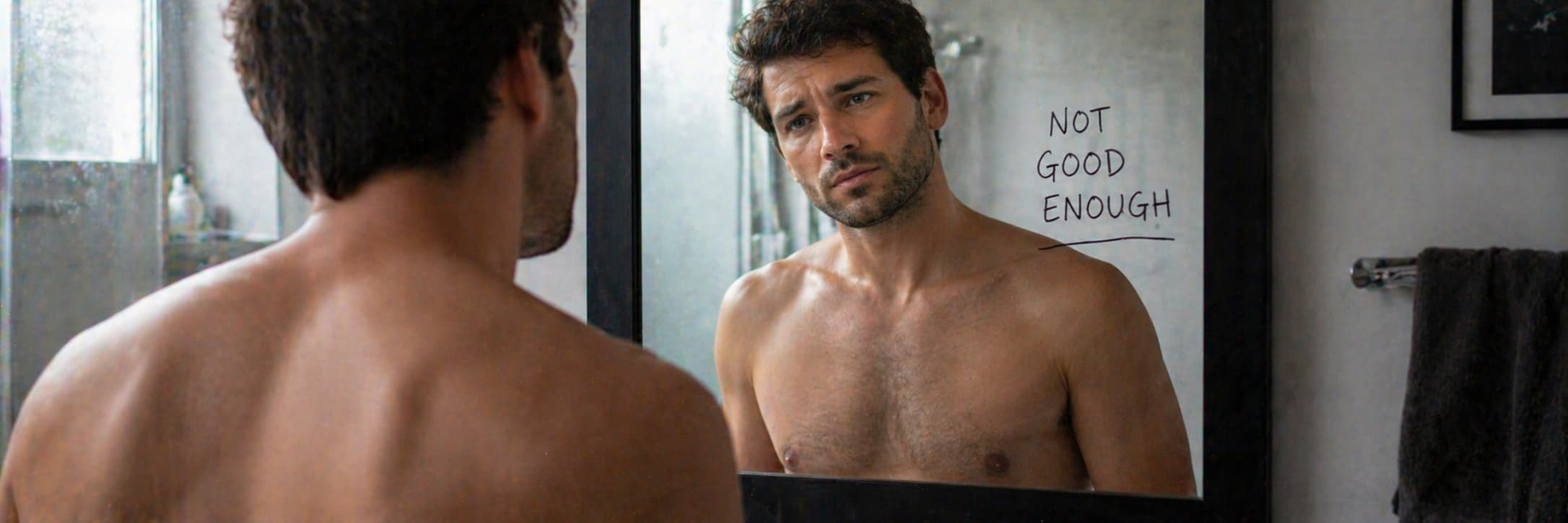
The pattern here is consistent and hard to miss in clinical work: gay men experience body image distress, disordered eating, and appearance anxiety at markedly higher rates than straight men. At the clinical end, eating disorders show up far more often than the wider population would predict. Body dysmorphia, muscle dysmorphia, and chronic dissatisfaction with how one looks are all overrepresented among gay men.
The explanation most often offered (that gay culture is visually focused and places a premium on physical appearance) is true but incomplete. It describes the surface without examining what drives it, and that matters for how the problem actually works and what can be done about it.
Gay male culture’s emphasis on physical appearance is not random. It developed in a specific context: communities of men who had, for much of their history, no legal or social legitimacy. In that context, physical appearance became the primary metric for sexual access, social belonging, and status in communities that lacked other structures for hierarchy and recognition.
Apps formalised and accelerated this. Grindr and its successors made what had previously been implicit evaluations into explicit ones: you are sorted by proximity and judged in approximately three seconds on the basis of a photograph. The app’s mechanics produce a specific kind of bodily anxiety: the awareness that you are being assessed continuously, that your acceptability is always potentially on the line, that the wrong body at the wrong time means invisibility.
This sits on top of something older. Gay men who grew up with internalised shame about their sexuality often develop a complicated relationship with their bodies early. If what you are is unacceptable, managing the body becomes a substitute: you cannot change your orientation, but you can control your appearance. Physical perfection becomes a form of compensation: a way of being acceptable in one dimension when acceptability in another feels out of reach. The logic rarely surfaces consciously.
In clinical work, body image distress in gay men presents across a spectrum:
“I spend more time thinking about my body than I do on my relationship, my work, everything else combined. I know that’s not right. I don’t know how to stop.” A client, in session.
For many gay men, body surveillance and body shame are intimately connected to the broader shame of internalised homophobia. The body became, early, a site where that shame was managed. The logic: if you cannot control what you are, control what you look like. If your sexuality makes you unacceptable in one register, compensate by being exceptional in another.
This dynamic tends to produce a particular quality of the problem: no amount of physical improvement resolves it. Men who achieve the body they believed would make them feel acceptable discover that the feeling they were seeking was not available through that route. The dissatisfaction relocates to a different feature. The goal shifts. The body remains insufficient.
That is the tell. When the goal perpetually moves, the problem is not the body. It is the psychological function the body is being asked to serve. No body can fulfil it.
“The body is not the problem. What the body is being asked to fix is the problem.”
See how we work together →Working with body image distress in gay men involves both the presenting symptoms and the psychological structure underneath them. For men whose body preoccupation is connected to internalised shame, the work addresses both: the habits of body surveillance and the shame that recruited the body in the first place.
The aim is not indifference to appearance or abandonment of physical care. It is a relationship with the body that does not require it to perform functions it cannot perform: resolving shame, securing belonging, guaranteeing desirability. A body is a context for a life. When it becomes a project of self-rescue, it is carrying more than it can hold.
For related reading, see Internalised Homophobia and Gay Shame and Compulsive Behaviour and Gay Apps.
For more clinical writing on gay male psychology, explore Unfiltered Clarity on Substack →
Gay men experience higher rates of body image distress and disordered eating than straight men, and clinically the difference is stark. The causes are structural: gay male culture has historically placed significant emphasis on physical appearance as the primary metric for social belonging, sexual access, and self-worth. Apps make these evaluations explicit and continuous. Add underlying minority stress from growing up with a stigmatised identity, and you have conditions that reliably produce heightened body surveillance.
It ranges from chronic dissatisfaction and preoccupation with specific features, to compulsive exercise, restrictive eating, avoidance of sex due to appearance anxiety, and clinical-level body dysmorphic disorder. What these presentations share is a relationship to the body that is primarily adversarial: the body as a problem to be managed rather than a context for life.
Yes. Muscle dysmorphia (a preoccupation with being insufficiently muscular) is disproportionately prevalent among gay men. It often coexists with behaviour that looks disciplined from the outside while functioning internally as body dissatisfaction. The goal is never quite achieved; the body is never quite enough.
Often directly. For gay men who grew up with internalised homophobia, the body can become a site where shame is managed. If you cannot control what you are, you can at least control how you look. Physical perfection becomes a form of compensation: a way of being acceptable despite the thing that makes you feel unacceptable. The logic rarely surfaces consciously, but it shapes the relationship to the body in predictable ways.
Yes. Clinical work can address the specific meaning the body carries for a particular man: the shame it was recruited to manage, the community belonging it was supposed to secure. Working with body image in gay men involves both the surface presentation and the psychological function it is serving. BACP-registered therapy is available online in the UK and select European countries.
Ongoing therapy for gay men in the UK, Ireland, and select European countries. Coaching, forward-focused and non-clinical, anywhere in the world.