
It is not neediness or weakness. It is what happens when early experiences teach you that your emotional state depends on someone else’s approval.
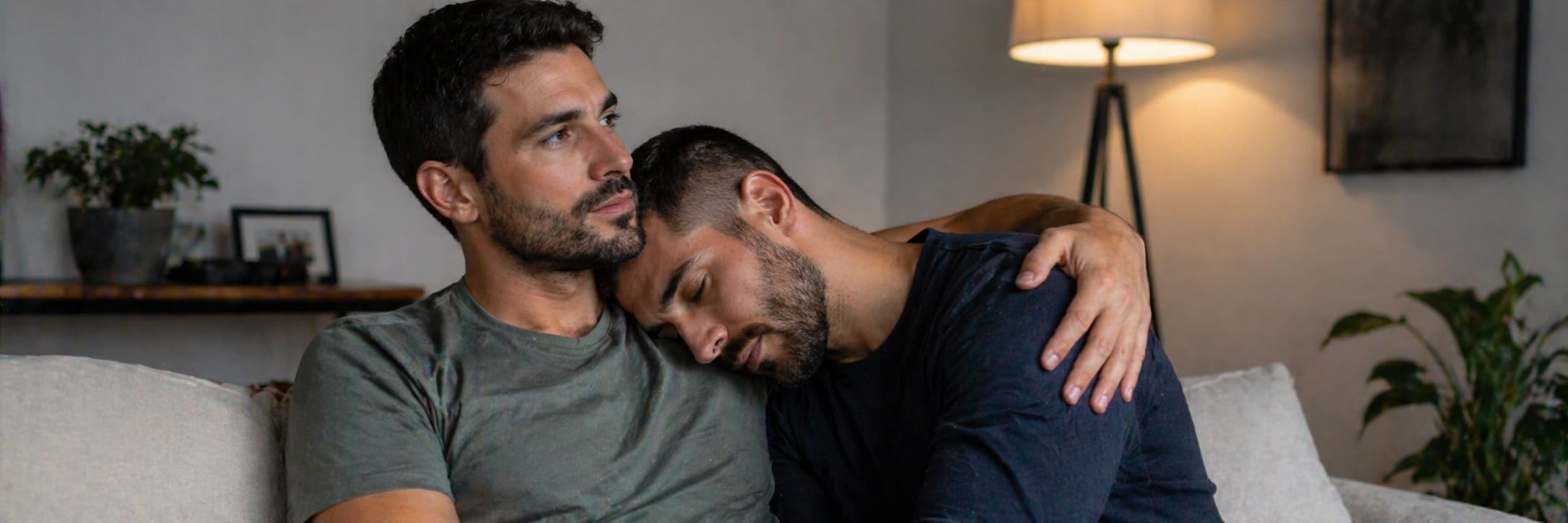
Gay men show up in therapy describing a pattern that feels like a character flaw: the intensity of needing a partner’s reassurance, the way a cold text message can collapse an entire morning, the inability to be content in a relationship without constant monitoring of whether the other person is still in it. They use words like “needy” and “clingy.” They are embarrassed by it.
What they are describing is not a character flaw. It is an attachment pattern, specifically a pattern of emotional dependence that developed in response to specific early experiences. Understanding where it came from doesn’t make it disappear, but it does make it workable. Which is more than most gay men get from years of trying to willpower their way out of it.
Emotional dependence (the experience of one’s emotional stability being contingent on a partner’s approval, presence, or mood) develops in environments where connection was conditional. Not where it was absent, but where it was present on conditions that the child had to learn and manage.
Gay men navigate a specific version of this. Growing up with an identity that required concealment, they often experienced affection and acceptance as contingent: available when they were performing the right version of themselves, threatened when they were not. The message wasn’t always explicit. It often arrived through the withdrawal of a father who sensed something different, the slight temperature drop when something gay-adjacent surfaced, the instinctive calculation of what was safe to be in this particular room with these particular people.
That is a specific school of emotional regulation. It teaches you that your internal state (your sense of safety and acceptability) is managed externally. You scan the environment for cues. You adjust accordingly. The problem is that this system, built for navigating conditional acceptance in childhood, continues operating in adult relationships where the conditions are entirely different.
“When he’s happy with me, I can do anything. When he’s quiet or distracted, I spend the whole day trying to figure out what I did.” A client, in session.
That description captures the central feature of emotional dependence: the other person becomes the primary regulator of the self. Not just an important person. The thermostat.
Emotional dependence in gay relationships has a specific complication: gay men often lack the early same-sex relational templates that might model secure, non-dependent male connection. Straight boys typically grow up with male friendships, male mentorship, male family relationships that demonstrate a range of how men can be together: close without intensity, caring without dependence.
Gay boys often grow up without that. Male closeness was either absent or charged with meanings that made it dangerous. When adult gay relationships become the first site of genuine male intimacy, they are asked to carry more than any relationship can hold. Not just partnership, but the entire history of what closeness with another man could have been.
“Emotional dependence is not about needing too much. It is about not having learned to hold your own weight. That can be learned.”
See how we work together →The clinical work with emotional dependence is not about becoming self-sufficient or emotionally independent. Those are not the goal, and pursuing them tends to produce disconnection rather than regulation. The goal is secure attachment: the ability to be genuinely close to another person while retaining access to your own internal experience.
That requires examining what the original conditional acceptance produced: which beliefs about yourself and relationships it installed, which coping strategies it generated, which adult situations activate the old alarm system. From that understanding comes the capacity to distinguish between the present relationship and the original formation.
For related reading, see Intimacy and Attachment in Gay Relationships and Absent Fathers and Gay Men.
For more on gay male psychology, explore Unfiltered Clarity on Substack →

Emotional dependence is a pattern where a person’s sense of stability and self-worth becomes heavily contingent on the presence, approval, or emotional state of a partner. In gay men, this often takes a specific form shaped by early experiences of conditional acceptance, where love or approval was reliable only when certain conditions were met. The result is an adult who finds it difficult to regulate their emotional state without external input.
Several factors intersect. Growing up managing an identity that required concealment teaches you to look outside yourself for cues about whether it is safe to exist as you are. Minority stress produces heightened sensitivity to social threat. And gay men often lack the early same-sex relational templates that might have modelled secure attachment. The combination makes emotional dependence structurally more likely, not a character flaw.
Common presentations include difficulty tolerating a partner’s independent interests, intense anxiety in response to relationship ambiguity, a pattern of losing one’s own opinions in deference to a partner’s, monitoring a partner’s mood as the primary barometer of one’s own emotional state, and difficulty ending relationships that are clearly not working because the prospect of aloneness is intolerable.
Related but not identical. Codependency typically involves a specific dynamic around one person managing another’s dysfunction. Emotional dependence is broader: it describes the pattern of needing external regulation regardless of whether the partner is struggling. Both respond to similar clinical approaches, but the framing matters for what gets examined in therapy.
Yes. The clinical work involves identifying the specific experiences that made external validation necessary, developing internal regulatory capacity, and distinguishing between genuine intimacy and dependence. This is about being able to be in relationship without being run by it, not about becoming emotionally self-sufficient or detached. BACP-registered therapy for gay men is available online in the UK and select European countries.
Ongoing therapy for gay men in the UK, Ireland, and select European countries. Coaching, forward-focused and non-clinical, anywhere in the world.